The
Colossus of Rhodes was a
statue of the Greek
Titan Helios, erected in the city of
Rhodes on the
Greek island of
Rhodes by
Chares of Lindos between 292 and 280 BC. It is considered one of the
Seven Wonders of the Ancient World. It was constructed to celebrate Rhodes' victory over the ruler of Cyprus,
Antigonus I Monophthalmus, who unsuccessfully besieged Rhodes in 305 BC. Before its destruction, the Colossus of Rhodes stood over 30 meters (107 ft) high, making it one of the tallest statues of the ancient world.
Siege of Rhodes
Alexander the Great died at the early age of 32 in 323 BC without having had time to put into place any plans for his succession. Fighting broke out among his generals, the Diadochi, with four of them eventually dividing up much of his empire in the Mediterranean area. During the fighting, Rhodes had sided with Ptolemy, and when Ptolemy eventually took control of Egypt, Rhodes and Ptolemaic Egypt formed an alliance which controlled much of the trade in the eastern Mediterranean.
Antigonus I Monophthalmus was upset by this turn of events. In 305 BC he had his son Demetrius Poliorcetes, also a general, invade Rhodes with an army of 40,000; however, the city was well defended, and Demetrius—whose name "Poliorcetes" signifies the "besieger of cities"—had to start construction of a number of massive siege towers in order to gain access to the walls. The first was mounted on six ships, but these capsized in a storm before they could be used. He tried again with a larger, land-based tower named Helepolis, but the Rhodian defenders stopped this by flooding the land in front of the walls so that the rolling tower could not move.
In 304 BC a relief force of ships sent by Ptolemy arrived, and Demetrius's army abandoned the siege, leaving most of their siege equipment. To celebrate their victory, the Rhodians sold the equipment left behind for 300 talents[2] and decided to use the money to build a colossal statue of their patron god, Helios. Construction was left to the direction of Chares, a native of Lindos in Rhodes, who had been involved with large-scale statues before. His teacher, the sculptor Lysippos, had constructed a 22 meter (70 ft) high[3] bronze statue of Zeus at Tarentum.
Construction
Ancient accounts, which differ to some degree, describe the structure as being built with iron tie bars to which brass plates were fixed to form the skin. The interior of the structure, which stood on a 15-meter- (50-foot-) high white marble pedestal near the Mandraki harbor entrance, was then filled with stone blocks as construction progressed.[4] Other sources place the Colossus on a breakwater in the harbor. The statue itself was over 30 meters (107 ft) tall. Much of the iron and bronze was reforged from the various weapons Demetrius's army left behind, and the abandoned second siege tower was used for scaffolding around the lower levels during construction. Upper portions were built with the use of a large earthen ramp. During the building, workers would pile mounds of dirt on the sides of the colossus. Upon completion all of the dirt was removed and the colossus was left to stand alone. After twelve years, in 280 BC, the statue was completed. Preserved in Greek anthologies of poetry is what is believed to be the genuine dedication text for the Colossus.[5]
To you, o Sun, the people of Dorian Rhodes set up this bronze statue reaching to Olympus, when they had pacified the waves of war and crowned their city with the spoils taken from the enemy. Not only over the seas but also on land did they kindle the lovely torch of freedom and independence. For to the descendants of Herakles belongs dominion over sea and land.
Possible construction method
Modern engineers have put forward a plausible hypothesis for the statue construction, based on the technology of those days (which was not based on the modern principles of earthquake engineering), and the accounts of Philo and Pliny who both saw and described the remains.[6]
The base pedestal was at least 60 feet (18 m) in diameter and either circular or octagonal. The feet were carved in stone and covered with thin bronze plates riveted together. Eight forged iron bars set in a radiating horizontal position formed the ankles and turned up to follow the lines of the legs while becoming progressively smaller. Individually cast curved bronze plates 60 inches (1,500 mm) square with turned in edges were joined together by rivets through holes formed during casting to form a series of rings. The lower plates were 1-inch (25 mm) in thickness to the knee and 3/4 inch thick from knee to abdomen, while the upper plates were 1/4 to 1/2 inch thick except where additional strength was required at joints such as the shoulder, neck, etc. The legs would need to be filled at least to the knees with stones for stability. Accounts described earthen mounds used to aid construction; however, to reach the top of the statue would have required a mound 300 feet (91 m) in diameter, which exceeded the available land area, so modern engineers have proposed that the abandoned siege towers stripped down would have made efficient scaffolding.
A computer simulation of this construction indicated that an earthquake would have caused a cascading failure of the rivets, causing the statue to break up at the joints while still standing instead of breaking after falling to the ground, as described in second hand accounts. The arms would have been first to separate, followed by the legs. The knees were less likely to break and the ankles' survival would have depended on the quality of the workmanship.
Destruction
The statue stood for 56 years until Rhodes was hit by the 226 BC Rhodes earthquake, when significant damage was also done to large portions of the city, including the harbor and commercial buildings, which were destroyed.[7] The statue snapped at the knees and fell over on to the land. Ptolemy III offered to pay for the reconstruction of the statue, but the oracle of Delphi made the Rhodians afraid that they had offended Helios, and they declined to rebuild it.
The remains lay on the ground as described by Strabo (xiv.2.5) for over 800 years, and even broken, they were so impressive that many traveled to see them. Pliny the Elder remarked that few people could wrap their arms around the fallen thumb and that each of its fingers was larger than most statues.[8]
In 654, an Arab force under Muslim caliph Muawiyah I captured Rhodes, and according to the chronicler Theophanes the Confessor,[9] the remains were sold to a "Jewish merchant of Edessa". The buyer had the statue broken down, and transported the bronze scrap on the backs of 900 camels to his home. Theophanes is the sole source of this story to which all other sources can be traced. The stereotypical Arab destruction and the purported sale to a Jew possibly originated as a powerful metaphor for Nebuchadnezzar's dream of the destruction of a great and awesome statue, and would have been understood by any 7th century monk as evidence for the coming apocalypse.[10] The same story is recorded by Barhebraeus, writing in Syriac in the 13th century in Edessa (see E.A. Wallis Budge, The Chronography of Gregory Abu'l-Faraj, vol I, p. 98, APA - Philo Press, Amsterdam, 1932): (After the Arab pillage of Rhodes) "And a great number of men hauled on strong ropes which were tied round the brass Colossus which was in the city and pulled it down. And they weighed from it three thousand loads of Corinthian brass, and they sold it to a certain Jew from Emesa" (the Syrian city of Homs).
Posture
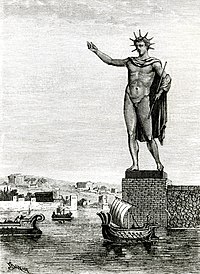
The Colossus of Rhodes depicted in 1880.
The harbor-straddling Colossus was a figment of medieval imaginations based on the dedication text's mention of "over land and sea" twice. Many older illustrations (above) show the statue with one foot on either side of the harbor mouth with ships passing under it: "...the brazen giant of Greek fame, with conquering limbs astride from land to land..." ("The New Colossus", a poem engraved on a bronze plaque and mounted inside the Statue of Liberty in 1903). Shakespeare's Cassius in Julius Caesar (I,ii,136–38) says of Caesar:
Why man, he doth bestride the narrow world
Like a Colossus, and we petty men
Walk under his huge legs and peep about
To find ourselves dishonorable graves
Shakespeare alludes to the Colossus also in Troilus and Cressida (V.5) and in Henry IV, Part 1 (V.1).
While these fanciful images feed the misconception, the mechanics of the situation reveal that the Colossus could not have straddled the harbor as described in
Lemprière's
Classical Dictionary. If the completed statue straddled the harbor, the entire mouth of the harbor would have been effectively closed during the entirety of the construction; nor would the ancient Rhodians have had the means to dredge and re-open the harbor after construction. The statue fell in 224 BC: if it straddled the harbor mouth, it would have entirely blocked the harbor. Also, since the ancients would not have had the ability to remove the entire statue from the harbor, it would not have remained visible on land for the next 800 years, as discussed above. Even neglecting these objections, the statue was made of bronze, and an engineering analysis proved
[citation needed] that it could not have been built with its legs apart without collapsing from its own weight. Many researchers have considered alternate positions for the statue which would have made it more feasible for actual construction by the ancients.


